
Could A Michigan Nuclear Plant Disaster Become The Midterms' October Surprise?
Sometime this week, without informing worried Michigan neighbors, a Holtec International team is launching a mission that could dramatically impact elections in Michigan and nearby states such as Wisconsin, Illinois, Ohio and Indiana.
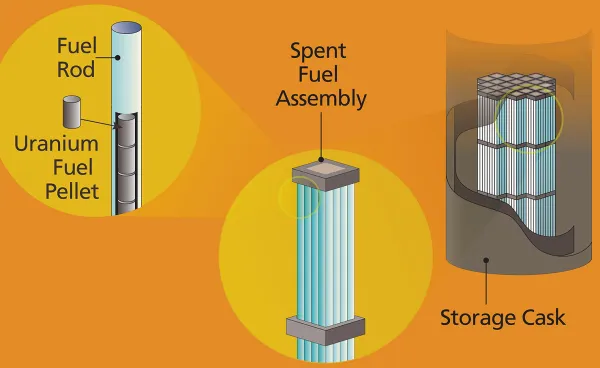
First they will attempt to squash a damaged and dangerously bowed fuel assembly into a shielded 49,000 pound steel canister. As they begin lifting this highly radioactive fuel out of the Palisades nuclear reactor the public will be in the dark.
Over the next 133 hours employees will attempt to drain water from the canister and move it through an escape hatch into the spent fuel pool. No reactor operator in the world has ever tried this due to the potential risk of radiation exposure to workers and the public.
This crisis is a big challenge for Holtec and President Trump’s Nuclear Regulatory Commission. On August 30 cameras were rolling for the media as the company began loading fuel in the first of more than 40 reactors it plans to open in America and Ukraine. After this spent fuel assembly tipped 30 degrees and crashed into the safety critical reactor core shroud, their opening day celebration was called off.
Instead of making history on its way to operating 3 Michigan reactors, backed up by as much as $16 billion in federal and state money, Holtec is in hot water on several fronts.
Already this New Jersey company has suffered embarrassing financial fallout. The August 30 disaster cooled investor interest, forcing the Holtec to abandon its $900 million Initial Public Offering road show.
Everyone from the New York Times to the Associated Press is now telling this irresistible story attracting the kind of attention normally reserved for marquee topics like the Jeffrey Epstein file. The Trump administration's bold campaign for a nuclear renaissance may soon be taking a big hit.
Republicans are especially vulnerable because of the president’s decision to downsize and “doge” the Nuclear Regulatory Commission last year. This plays directly in to what has gone terribly wrong for the Nuclear Regulatory Commission and its codependents at team Holtec who are victims of their own continuation bias.
The fact that the President's Trump Media has half interest in a multi-billion dollar nuclear power startup opens the Republican party up to charges of political corruption. Another problem for GOP candidates is the fact that the administration is out of step on energy policy. The White House has killed major wind energy projects at a time when utility bills are soaring. He has also pulled the plug on EV subsidies and cut support for solar. This has led directly to thousands of job losses.
These decisions work against our nation’s energy independence. Across the world renewable is expected to double over the next five years, a number equivalent to the power consumed today by Europe, China and Japan. Thanks to Republican policy changes our country’s projected renewable growth is expected to fall by 50 percent. The fact that renewables are far cheaper, safer and quicker to build plays directly into voter anxiety over soaring energy bills.
Nowhere does this story have more impact than the swing state of Michigan. If, for any reason, the unheard of plan to recover the 216 irradiated fuel rod assembly fails, there could be be political fallout in both blue and red states.
The fact that all this is happening inside a plant that is shut down and not producing electricity has a direct impact on Trump’s chosen leadership at the NRC. This was not supposed to happen.
If Holtec can’t get Palisades working soon the company, which has never produced a single kilowatt of nuclear power, may not be able to begin repaying a $1.52 billion Department of Energy loan that begins coming due in March.
The exodus of the company’s president, chief operating officer and chief safety officer in recent months is not reassuring. Equally troubling is the fact that veteran Holtec employee and plant manager Jeff Borah recently told the New York Times the company did not have a plan when it embarked on the restart. He compared his employer's approach to “trying to build a fire truck on your way to a fire.” Borah left the company in August, close to the time of the refueling disaster.
Some critics contend that if the NRC approved emergency plan to rescue the damaged fuel assembly fails, a radiation release could lead to an evacuation order for the control room and the plant.
Holtec, its fuel assembly rescue plan vendor and the NRC have carefully run the numbers and insist all this is impossible. They maintain that the only reason the NRC issued the requested “emergency license amendment” was financial. Both of them rule out the possibility that anyone could be seriously injured due to a radiation release triggered by the airborne transfer of the fuel rods.
Giving the regulator and the operator the benefit of the doubt, it would be good to know why the agency set a ten day deadline for completion of the recovery operation. Given the fact that the plant is more than two years behind its original startup date, it’s hard to understand the rush.
Regardless of the risks involved, key facts are beyond dispute. At the moment Holtec is unable to safely move this stuck and deformed assembly via an underwater channel to the safety of the borated spent fuel pool.
The unique and unprecedented recovery effort is surrounded by the kind of secrecy you’d expect to see at a nuclear weapons depot. Decision making is in the hands of Nuclear Regulatory Commission officials communicating with Holtec via a secure channel. Virtually all public comment has been rejected by the NRC which is not considering a news conference.
Part of what adds suspense to this fuel transfer effort is the fact that the entire bowed fuel assembly does not fit inside the heavy fuel transfer container.
Team Holtec and the NRC contend that when the transfer container lid shuts it will easily bend the bowed stainless steel fuel rods back into their original position. This approach is a bit like sitting on top of a packed suitcase to close a stuck zipper.
Only a handful of people at Holtec and the NRC will immediately know if this attempt to rescue the wounded fuel assembly is working or backfiring. For lack of a better word, the agency has come up with an acronym for what’s going down at Palisades, FOAK, aka First of A Kind effort.
Holtec and the NRC have prepared a worst case scenario analysis for this emergency plan. It’s possible workers could receive up to 60 percent of their allowable annual exposure if something goes wrong during the time the fuel transfer is in the air. Any event that unshields the fuel transfer container while it is in the air could have dangerous unintended consequences.
Adding to the concern of Palisades neighbors like Dr. Bruce Davis is the fact that the agency and its predecessor, the Atomic Energy Commission, have a history of not reporting nuclear safety emergencies in a timely manner. After a partial meltdown at the Monroe, Michigan Fermi Reactor in 1966, the public waited nine years before the frightening story was revealed in John G. Fuller’s classic text, We Almost Lost Detroit.
Like the fuel assembly drop that was hidden from the public for weeks, the NRC was slow to report a Palisades work place radiation exposure event earlier this year. When it does promptly release details on events, like a worker falling into the dangerous reactor fuel cavity pool, there are no consequences for Holtec’s negligence.
Dr. Davis and other Palisades neighbors I have spoken with worry that failure to successfully move the fuel transfer container could expose employees and the public to potentially dangerous radiation. Hard as it is to believe, these emissions would fall within the NRC’s legal exposure limits even if they prompt evacuations of workers and people living near the plant.
Don’t Waste Michigan’s Kevin Kamps, who has been watchdogging Palisades for 35 years, points out that that the "NRC is fine with Low Population Zone dose receptors (aka Palisades Park residents like the Davises) getting more than 6 Rems from the fuel handling accident scenario.
"What's shocking to me about it is nuclear workers are limited to 5 Rem per year. So local residents are allowed to get more radiation exposure than a nuclear worker? And this is considered acceptable?”
Dr. Davis is especially worried that an evacuation order from the NRC and the Governor’s office could take more than an hour to reach his neighborhood plagued by poor cell service. That is why he and his wife Karen have a home Geiger counter.
“She and I would like to know when this fuel assembly rescue operation is going to happen,” says Dr. Davis.
“We'd like to be out of town before they get started. The NRC won’t give us a window so we can know when to leave. Right now we have our bags packed, just in case. We don’t want to be guinea pigs."
Of course legislators from both parties who funded this restart will want to find out why the NRC failed to prevent this disaster. One of them is Senator Ed Markey who has already cut a YouTube video about Holtec’s challenges and done interviews aimed at halting the Palisades startup. This kind of activism questions leadership at the NRC, an agency which has never taken responsibility for screwups at the many plants it is supposed to regulate.
Particularly alarming is the way the agency has rushed through the emergency license amendment process written to benefit owners of operating reactor. Typically this is done for a short time when workers at a plant producing electricity are waiting for fast delivery of a pump or similar component.
In this situation the plant is allowed to remain in operation until the fix is complete. No operator has previously received this kind of emergency license amendment for a plant that is not up and running.
Today Holtec is uniquely out of compliance with federal reactor code. Especially concerning is the NRC’s failure NRC to do its required ten year plant inspection in 2015. Right now the regulator has no plans to force Holtec to catch up on this long overdue inspection.
Like a doting grandparent, the NRC has endlessly conceded to Holtec’s cries for help. So many waivers and exemptions have been granted that it can take days to read through them all in the NRC docket.
For example the plant fails to meet the critical nuclear plant fire safety code in place since 1975. In August Palisades received its sixth waiver on work hours. At the time of the August 30 fuel loading disaster, some critical Holtec workers were allowed to be on the job 54 hours a week and take only three days off every 15 day work period.
Alan Blind, former head of design engineering at Palisades when it was owned by Entergy, has asked the NRC if worker fatigue contributed to the fuel loading fiasco. Blind, the former vice-president for nuclear at Consolidated Edison, also wants to know if the plant’s new chief safety officer was on the job August 30.
Trump and Secretary of War Pete Hegseth are both vulnerable on this issue. They will have a lot of explaining to do in the midst of what could become as well reported a story as the Boeing Max disasters. The NRC/Holtec failures put the spotlight on the President’s attempt to let safety critical industries like nuclear and AI self-regulate. Trump’s plan to let Hegseth install potentially unshielded demonstration reactors at military installations is especially worrisome.
If Trump’s NRC fails to end Holtec’s pattern of mistakes this controversy could quickly emerge as a national public health issue. It could also cause reputational damage to the entire nuclear power industry.
Eager to provide aid and comfort to an industry that has only managed to build two new light water reactors in this century, the President continues fast tracking the restart of Palisades and shut reactors in Pennsylvania and Iowa. This approach is aimed at cutting down the lead time to build light water reactors that can take 15 years or longer.
Some of his conservative brethren oppose government funding for plants like Palisades. Even the conservative Heritage Foundation has opposed this Holtec brand of corporate socialism that will inevitably raise the national debt.
At the state level this could damage the campaign of Trump enthusiast Mike Rogers who is landing hard on opponent Abdul El-Sayed’s Arab ethnicity. Via a $100 million plus PAC fueled campaign fund he has accused the Michigan Democrat of nearly everything short of being Osama Bin Laden’s love child. That approach could quickly fall short in the face of a public health crisis triggered by fears about a potential Palisades disaster.
For physician and Detroit/Wayne County Public Health official El-Sayed, the Palisades crisis underscores his claim that Rogers is a stand-in for the "politically corrupt" Trump administration.
There is no quick way for the Republican candidate to pivot and come out on top in the midst of breaking Palisades news coverage. In his entire career he has never said a bad word about advancing nuclear power.
This could also be bad news for veteran GOP Congressman Bill Huzienga, a die-hard Trumper who sees Palisades as an economic engine for his West Michigan Congressional District.
Any way you look at it, this story is a textbook example of what happens when government regulation fails. This obsolete nuclear reactor dumped by both Michigan’s top utility Consumers Power (now Consumers Energy) and fleet operator Entergy spans five decades of trouble and turmoil. In both cases the owners concluded Palisades was too expensive to operate, The cost of safety upgrades were well beyond either company’s budget.
Holtec supposedly bought the plant in 2022 for decommissioning. Initially drawing on money from the decommissioning trust fund, the company quickly pivoted to a restart.
Because the New Jersey firm did not have an operating license, it was free to begin modifying central systems like the obsolete steam generators under the debatable theory of “implied consent.”
The company made significant changes to the plant without going through the normal process of submitting plans for NRC approval. Along the way there were many problems. including the fact that important Entergy plant records turned out to be missing and unaccounted for.
After Holtec finally received its operating license in the summer of 2025, the company asked the NRC for forgiveness on all its unpermitted work. The company sought and received a series of NRC waivers on unauthorized work in a number of key areas including welding on reactor vessel closure head penetrations. This work failed to comply with American Society of Mechanical Engineers standards.
Again and again the NRC granted generous waivers against the opposition of nuclear power experts like Blind and Arnie Gundersen who has done work at 70 reactors over the past 50 years. Some of these critics spent months preparing for hearings and, in the case of Don’t Waste Michigan, filed lawsuits in federal court to halt the restart. The agency shot down all efforts to force Holtec to comply with regulations governing the rest of America’s nuclear reactors.
This time around the NRC is not taking the time to schedule customary public hearings these experts have been attending for the past four years. After burying notice of its decision to grant an emergency license amendment in small type legal ads, public comment notification, normally spread out over weeks, was limited to a single day, October 8.
The agency quickly rejected all but one of the comments because they were not considered relevant to the emergency license amendment. It has not even bothered to follow its own requirement to notice the emergency licensing amendment in the Federal Register.
Today many people on all sides of the nuclear energy debate want to know why the traditionally slow moving agency rushed its approval of Holtec’s plant to remove the bowed fuel assembly from the reactor.
Nuclear power experts Blind and Gundersen worry that the bent fuel rods could rupture and release radiation.
Why jump ahead when a public hearing and NRC deliberation could lead to a more reliable solution that doesn’t take the risk of lifting the fuel assembly into the air?
Good answers to that question may surprise you as much as it did me, an investigative reporter living 70 miles from Palisades.
I’ll have more details soon on possible reasons why the normally slow moving NRC is pushing Holtec to quickly remedy this problem before there is another crisis at Palisades.
Roger Rapoport has written about Palisades for The Detroit Free Press, The Progressive and Counterpunch. He and Pete Bosheff produce the Nuclear Reactor Next Door Podcast. You can see his articles at this link.